
If March is ‘in like a lion, out like a lamb’, then what is February? Seemingly interminable greyness, a cold, damp clamp, are we stuck in the lion’s maw? On Tuesday we had a day to lift the soul with real warmth and blue skies, on Wednesday rain that Galway would be proud of. It was dizzying running down the road awash with Willy Wonka white chocolate caramel water – fields losing their fertility. Weather as mercurial and capricious as the confectioner himself, poor Charlie Bucket, full to the brim.
Despite all of this, there are some garden stalwarts that choose to shine through the darkness. Sweet box, Sarcococca confusa, has been flowering since Christmas. There are a number of mature plants, five feet tall, lining the bottom of the Dell at the Hermitage. This is a shaded area at the base of a steep slope north of the Orchard. I could smell the strong, sweet scent when fruit pruning in January. Outdoors the cloying smell is diluted on the air and is enticing; up close and indoors it can be too much. Fine-textured with small evergreen leaves it carries pitch-black shiny berries alongside the whiffy starry white flowers. It is also solidly, nailed-on deer proof. Plant them next to a gravel path and you will find seedlings that can be pricked out and given away to friends.

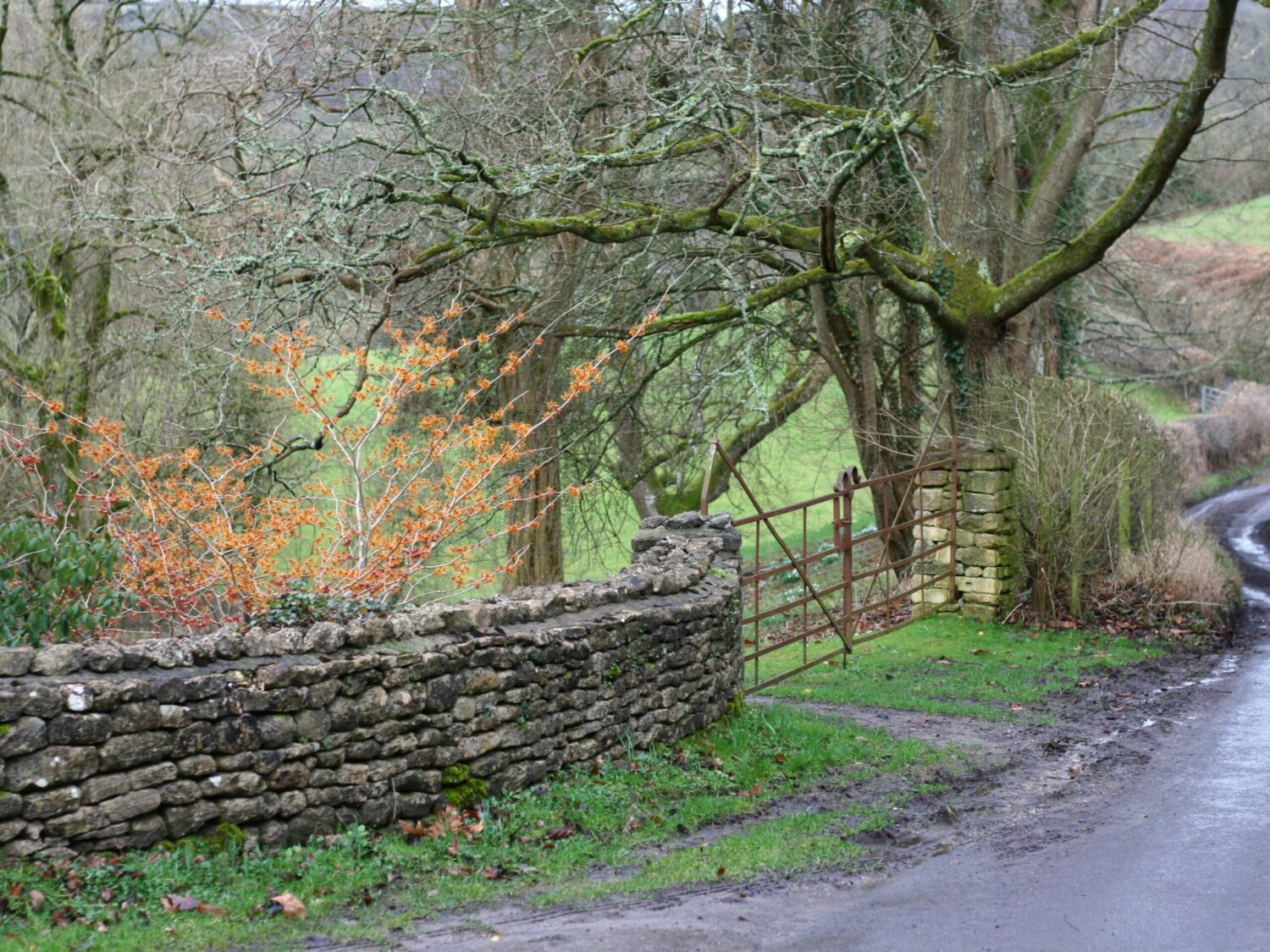
When the garden was redesigned in 2015 three witch hazels were planted close together beside the country lane that leads to the Hermitage. This is often done when a garden is first planted to help it feel fuller. Two have survived, the orange-flowered Hamamelis x intermedia ‘Aphrodite’ and a red variety called ‘Diane’. Of the two, ‘Aphrodite’ is strongest, broadest and tallest. For me it’s irrefutable: hamamelis flowers smell like tinsel, and six weeks too late, conjure wonderful memories of childhood Christmases. They can eventually be quite weighty reaching 4m or so in all directions, but it takes a while, and the advice is to buy time by getting the biggest plant you can afford. Dan Pearson has written about witch hazel several times on his brilliant blog Dig Delve and I would urge you to seek it out.

When we take on a new garden, it’s important to look backwards and see the weight of time measured in growth. In minutes, a plant that has taken years and many hours of invested care, can be removed. The luxury of space and a new beginning are necessary to achieve a new vision, but it is worth reflecting on what will be lost before wielding the tools. I am grateful for those before me that have planted and cared for the finest winter flowering shrub at the Hermitage – a Daphne odora ‘Aureomarginata’.

Tucked away into a cool pocket between the porch and a time-worn oak door, this shrub with its confident, luxuriant and shiny leaves edged delicately in golden-cream owns this corner of the garden. Five feet tall and broad, it comes into its own on a damp, still grey day in February as the white with pink-purple flowers produce a sweet, heavy, prehistoric smell that attracts early queen bumblebees and grumbling gardeners. My eleven-year-old son has a good nose for scent. When I brought a sprig home having carelessly snapped it off during rose pruning, I asked him what the smell reminded him of. He recalled playing beneath the branches of the den-like Magnolia grandiflora on the terrace of the American Museum and thought it smelled just like its large goblet-shaped flowers.

Daphnes do well at the Hermitage because they are deer proof and enjoy alkaline soil so I am keen to add more. They can be roughly divided into 3 loose groups. There are those which need sunshine (but being woodland-edge plants to remain cool at the root) such as D. odora, D. x transatlantica and a yellow-flowered variety called D. gemmata ‘Royal Crown’. There are those which require more shade such as native D. mezereum, D. laureola, D. pontica and the excellent D. bholua which contains cultivars that captivated me at Wisley such as ‘Jacqueline Postill’ and ‘Darjeeling’. The final group are dwarf varieties most suited to an alpine garden.
It’s important to make sure they are looked after well in their early years and get enough water during summer months. They will not tolerate winter wet, and most will benefit from an annual mulch to keep the roots cool. They are deep rooted so won’t tolerate being in a pot for more than a couple of years and although they are not supposed to tolerate moving, I have successfully lifted and shifted ‘Eternal Fragrance’ twice, both times in the spring while young. They are expensive plants because they are slow growing and tricky to propagate. Pruning them is only necessary if they are overstretching themselves and I try to do it as lightly as possible after they have flowered.
As with snowdrops, plants like these that defy the lion’s roar are a welcome, warming tonic for the soul. They make me want more. Among many there are trees and shrubs that have appealing bark like the Tibetan cherry, Prunus serrula; there are early flowering daffodils to explore; shrubs with colourful stems – dogwoods, willows, ghost brambles; and of course hellebores. A chocolate box Mr Wonka himself would be proud of. Is that too much to ask?
Leave a Reply