
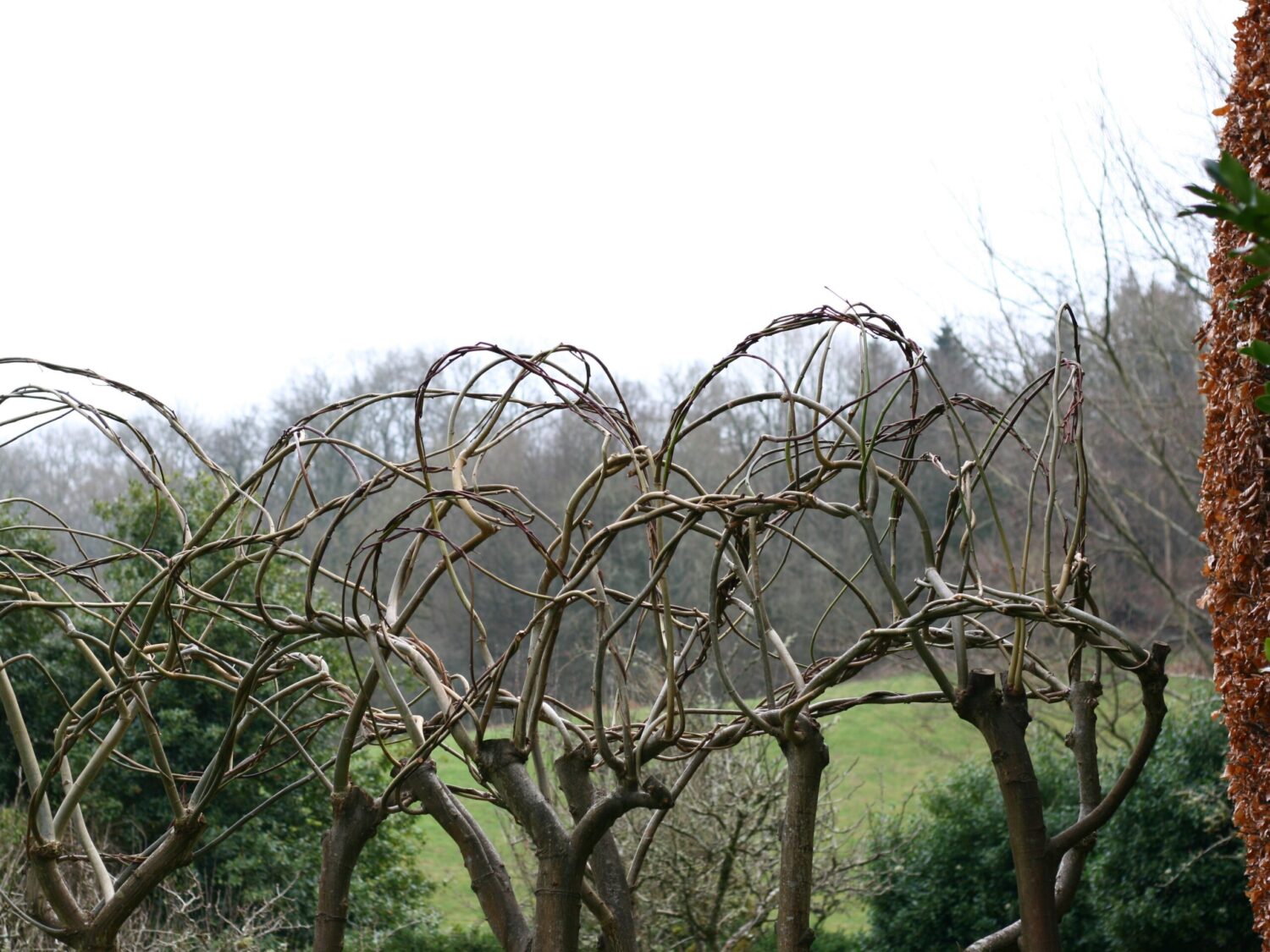
When I was eleven I went on a school trip to Paris and Normandy. I had an old camera with a mechanical film winding lever that made a satisfying noise when flicked over. When the film was eventually processed, over half the photoraphs showed pollarded and pleached street trees taken through the coach window! They were truly awful, but they showed that this regimentation of something natural landed on my psyche. Perhaps they even marked the beginnings of a gardener’s eye?
Gardens fall upon a continuum of control. The Bagel Garden by Martha Swartz an example of extreme control (and daftness) at one end, through to something like the highly naturalistic ‘non-garden’ in California designed by Ron Lutsko. Mostly however, gardens are composed of various contrasting elements that fall on different parts of the continuum. Great Dixter in Kent is renowned (among many other things) for juxtaposing tightly clipped yew topiary and orchid-studded meadow to great effect.
To work within this framework of control, our actions as gardeners can be additive (planting, staking, seed sowing) or subtractive (weeding, pruning, mowing). They can also be both simultaneously. Pruning and shaping plants within a garden (topiary, hedges, fruit) while being subtractive on a practical level, creates a structure with weight and character which adds to a garden by setting the mood for a space.

I try to keep this in mind now during the annual prune. The upper part of the Orchard at the Hermitage has an odd ‘room’, approximately five by ten metres, and enclosed on three sides by three different structures. A beech hedge, a row of pleached limes and a row of loosely espaliered apples and pears. Within sits a small lawn. I’ve always found this part of the garden unsettling. It jars with the simplicity of the orchard and confuses movement through the garden.

It is saved in late spring by uniform clumps of snowflake (Leucojum aestivum) and in summer by a small cadre of bee orchids (Ophrys apifera). The pleached limes however are bothersome. In my first winter I couldn’t bring myself to repeat the same pattern. Instead, when the conversation of pruning began, rather than blithely remove stem after stem, I decided to twine some together to create visual interest and engage with the spaces between the stems. Each year builds on the previous and the sculpture becomes heavier and more intertwined.

Training roses benefits from the same thoughtful approach. For me it began last week with the first climbers and the shrub roses in the cutting garden. In recent years there has been a movement away from traditional approaches to rose training. Over ten years ago, at Woolbeding, we trained long shoots horizontally on walls and pruned side shoots back to two or three buds. Today it has become far more dynamic with swirling, curling, sculptural installations adorning walls and social media alike. Once you’ve clapped eyes on Jenny ‘Niff’ Barnes’ work, it is hard to resist giving it a try.
I begin with RHS doctrine. With sharp, clean secateurs, remove or remedy all dead, damaged and diseased shoots. Then give old, unproductive shoots are the chop. Young, skinny, runty shoots next. This brings immediate clarity. The longest shoots are then trained by arching and fixing them in place with a hazel stake driven in the ground. If I don’t work with the natural desire of the branch, I’m chastised by its splitting. A network of criss-crossing stems is created to provide strength to the overall structure. Each node is tied with 4-ply string and a clove hitch. This is in direct contravention to RHS scripture where all crossing branches must be removed not encouraged.

It makes sense that it works. Curving the stems prevents apical dominance and forces sideshoots laden with flower buds to grow along their length. The result is a rewarding show of flowers across the entire structure in late May and June. And ensuring the stems are tightly twined prevents excessive bark rubbing and potential for disease. Even if some stems are damaged, a healthy rose produces plenty of new long shoots to tie in the following year. Ultimately, the most important thing is to work with the nature of the rose which will vary depending on variety, location and age. Thus begins the conversation.

Leave a Reply